
Buying property in Tbilisi is an attractive investment, but the Georgian market has its own unique characteristics — from high seismic activity to the legal consequences of utility connections. If you don’t want years of litigation or costly renovations from overshadowing the joy of your new home, a comprehensive property audit is a must. This process covers two critically important aspects: the physical condition of the property and its legal title.
The Georgian construction market is relatively open, yet it lacks the robust buyer-protection mechanisms — such as compulsory insurance for off-plan purchasers — that are standard in EU countries. When evaluating properties, it is important to recognize that Tbilisi’s housing stock was built in different historical periods, each with its own technical characteristics.
Many buildings date from the Soviet era, others from the early 2000s, and others yet from the last fifteen years. Building standards in the country do not exist in a vacuum: Georgia has been systematically developing and refining its regulatory framework, progressively tightening requirements for material quality, energy efficiency, and the seismic resilience of new developments.
Given this multi-layered market, the responsibility for thoroughly examining a given property before purchase falls squarely on the buyer — or their independent consultant. To lend this process more clarity, structure, and predictability, we have prepared this guide.
The technical inspection: structural integrity and hidden defects
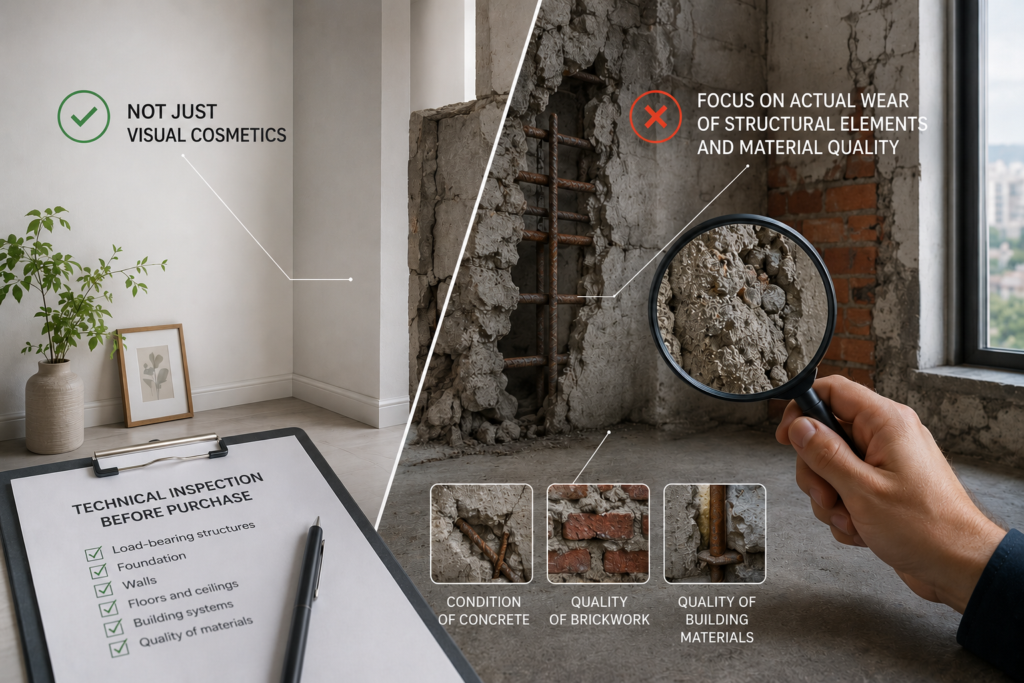
The physical condition of a property is about more than just cracks in the walls — it is about the fundamental safety of the building. Tbilisi sits at the collision point of tectonic plates, placing the city in a seismic intensity zone of up to 8 points on the MSK scale. Destructive earthquakes are extremely rare in the capital, occurring at intervals of several centuries, though imperceptible micro-earthquakes of up to 3–4 points are recorded on a regular basis. This is precisely why it is so important to assess the actual wear of the load-bearing elements and the quality of the construction materials when purchasing property and not just the cosmetic finish.
Seismic Resistance and Structure
The first thing examined during a technical audit of property in Tbilisi is the type of foundation and the grade of concrete used. For modern high-rise buildings (such as those in complexes like Maqro City), the standard is a pile foundation — which absorbs seismic vibrations — and the use of high-strength B35-grade concrete. If you are considering low-rise construction, it should feature a monolithic reinforced concrete frame. If the building is situated on a slope, it is critically important to confirm the absence of deep cracks in the load-bearing walls, as these can signal dangerous ground subsidence.
The Condition of the Frame: What Are You Actually Buying?
In Georgia, the terms «black frame» and «white frame» can mean different things depending on the developer, so your contract should include a clear description.
Black Frame
Typically includes only the shell — the structural walls and partitions. Interior finishing and utility rough-ins are absent.
White Frame
When the property is ready for the finishing touches. Usually includes plastered walls (gypsum or cement render), a finished screed floor, and basic rough-in plumbing and electrical wiring brought to connection points.
Since there is no unified national standard for these terms, it is critically important to compare the actual condition of the property against the detailed specification in your contract and technical passport. This will spell out the developer’s obligations and allow you to plan your finishing budget accordingly.
Check the quality of window installation (no draughts), the levelness of the screed (no voids or gaps), and the presence of waterproofing in bathrooms and on balconies.
It is important to note that Georgian law does not regulate uniform standards for frame-condition properties, so developers define them independently.
For example, some companies include electrical rough-in wiring in the finishing package, while others do not. It is therefore essential to read the contract carefully to confirm that all work has been carried out in strict accordance with the terms stipulated therein.
Engineering Systems and Hidden Mould
Due to the local climate and ventilation failures, mould is a common problem. A professional thermal imaging survey is an important step that forms part of a technical property audit in Tbilisi.
Consider the following real-life case. A buyer purchased an apartment with a high-end renovation in the historic centre of Tbilisi. The legal due diligence revealed no encumbrances, and the transaction appeared flawless. After living there for a year, however, the owner developed a severe allergic reaction.
The source of the problem was only discovered after partial dismantling of the wall cladding: behind the decorative panels lay extensive colonies of black mould. The cause was a failure of the building’s foundation waterproofing — something the buyer had no knowledge of.
As a result, the owner was faced with the complete demolition of all finishes, expensive remediation treatment, and the subsequent forced resale of the property.
🚩 Although even the most experienced specialist cannot always predict future problems on the basis of a visual inspection alone, a professional technical audit using specialist equipment — such as thermal imaging cameras — makes it possible to identify existing risk zones: hidden moisture beneath the finishes and waterproofing defects that are invisible to the naked eye. An instrumental survey gives the buyer an objective picture of the condition of the walls and floor slabs, identifying possible critical red flags and protecting the investor from the purchase of a property with serious structural defects.
Verification of the Actual Floor Area
A discrepancy of 2–5% between the actual floor area and the figures in the technical passport is a widespread global phenomenon, and Georgia is no exception. Such discrepancies often arise from differences in measurement methodologies (for example, how partition wall thicknesses, recesses, or balconies are accounted for) or as a result of alterations carried out to the property. Nevertheless, these percentages can translate into several square metres that you are effectively overpaying for. An instrumental measurement carried out at the audit stage allows the exact area to be established and provides a well-founded basis for adjusting the final purchase price.
Legal due diligence: protecting your rights

Legal due diligence serves as a kind of insurance policy and helps you uncover hidden threats before you’ve put your pen to paper.
🚩 Remember: A registry extract is just the tip of the iceberg and may not always reveal the history of litigation or urban development risks.
The Public Registry (Amonatseri)
Georgia’s Public Registry (napr.gov.ge) is a highly efficient electronic database with minimal bureaucracy.
According to the World Bank’s global Business Ready ranking (source), Georgia ranks 2nd in the world for the operational efficiency of government services. The system allows you to obtain an up-to-date digital extract with the key details of a property by its cadastral code in just 10 minutes. However, speed does not necessarily mean transparency: an extract shows the current status. A thorough expert analysis is required to uncover the hidden risks.
To obtain the information you need to make a well-informed decision about a purchase, the following must be examined in detail:
Owner: Who is actually selling?
Confirm that the person you are negotiating with is registered as the sole and legitimate owner. Do not limit yourself to the current entry — study the history of title transfers. Unusually frequent resales of a property over a short period may be a sign of fraudulent schemes or an attempt to conceal serious structural defects.
Land status: The agricultural designation trap
This point is critically important for those considering the purchase of private houses, townhouses, or property on the outskirts of Tbilisi (for example, in Didi Digomi or Saburtalo). In Georgia, foreign individuals and legal entities are legally prohibited from owning agricultural land. If a completed multi-apartment building has already been constructed on a plot, but the land beneath it has not been officially reclassified as non-agricultural, the Public Registry will refuse to register the title in the name of a foreign national.
🚩 A commercial note: plots with agricultural status are significantly cheaper. It is precisely because of this low land cost that developers often begin construction on such plots, passing the future legal risks on to buyers.
It is possible to change the designated purpose of the land, but this is a complex, multi-stage, and strictly regulated bureaucratic process (we will cover the detailed procedure for changing land status in a separate article). Until the status is officially changed in the registry, a transaction of this kind carries enormous risks for a foreign investor.
Encumbrances, mortgages, and freezing orders

The extract should be clean. The property must be thoroughly checked for mortgages, tax liens (the owner’s debts to the state), and disposal restrictions imposed by enforcement officers. If a mortgage exists on the apartment, the purchase can only proceed with the involvement of the lending bank — otherwise the contract may be voided. You should also check for registered tenancy rights: in Georgia, long-term tenants retain the right of occupancy even after a change of ownership.
Spousal consent: the invisible risk.
It is important to understand a technical peculiarity of the Georgian Public Registry: if only one person is listed as the owner in the extract (for example, the husband), the system allows him to sell the property without providing official consent from his wife. From the registry’s perspective, such a transaction is sufficient to transfer ownership rights.
However, if the property was acquired during the marriage, it is legally considered joint marital property. Ignoring this fact carries serious risk: the absence of notarised spousal consent is one of the most common grounds for challenging real estate transactions in Georgia years after the fact. To protect your investment from future claims and litigation, a professional audit must include verification of the seller’s marital status and the obtaining of official spousal consent to the sale.
Developer and Permit Verification
Buying off-plan — at the foundation pit stage — is always an investment in the future. The opportunity to purchase a property at 20–40% below its post-completion market value is extremely attractive, but this advantage is only justified when the developer is reliable and the project is legally sound. Unlike in the EU, there are no robust compulsory insurance mechanisms for off-plan buyers in Georgia, so the responsibility for verifying the safety of a transaction falls entirely on the investor or their consultant.
To avoid turning an investment into an indefinitely stalled project, the following aspects must be examined in detail:
Building permit
Without this, off-plan sales have no legal force. However, simply confirming the existence of the document is not enough — a professional audit includes the permit’s status, whether it is currently valid or has been suspended by the Tbilisi Municipality due to violations. We also strongly recommend cross-referencing marketing brochures against the official architectural project registered with the City Hall. It is essential to confirm that the number of floors, the location of utility infrastructure, and the actual layout correspond to what is being promised in the sales office. Any deviation from the approved project may become grounds for refusal to issue the building’s certificate of occupancy.
The land title under the development
You must have a clear understanding of whose land your future home is being built on. The ideal and safest scenario is one where the plot is owned by the developer itself. If the land is leased or belongs to a third party (a partner), a serious risk arises of corporate conflict or legal dispute between the landowner and the developer with the potential to lead to the immediate and indefinite suspension of construction. In addition, the designated land use must be verified: the documents must confirm that the plot is designated specifically for the construction of a multi-apartment residential building.
Project history and red flags

A reputational audit of the company often yields more insight than dry figures in a contract. Study the developer’s portfolio: how many projects have actually been delivered and how frequently has the company missed handover deadlines? The following warning signs are reason to walk away from a transaction:
- The company is not registered in the National Registry (Public Registry)
- The company has significant tax arrears or assets under arrest
- There are active legal proceedings with contractors or previous buyers
- The price is suspiciously low — significantly below the market average for the area
- The developer refuses to provide original land title documents or project documentation for review
Transparency of contract terms
Remember that any verbal assurances regarding so-called guaranteed timelines have no legal force — only a signed document counts. The contract must clearly set out the price, floor area, a construction milestone schedule tied to payment instalments, and the developer’s specific liability for delays in handing over the property. A professional contract audit will protect your interests in the event of unforeseen circumstances on the construction site.
Developer track record
How many projects have actually been delivered, as opposed to merely completed to a certain stage? Were there delays, and what were the stated reasons? Key indicators include the absence of major litigation with contractors or buyers and a transparent ownership structure for the company. The developer avoiding dialogue or refusing to provide land title documents is a red flag — get out.
Certificate of occupancy and utility connections
For new builds in the final stages of construction, it is critically important to verify the existence of the state certificate of occupancy. Purchasing a home in a building that has not passed this procedure means that the property legally remains a construction site. In this situation, residents are forced to pay for electricity at the higher commercial tariffs applicable to legal entities, while connections to the main gas supply and the opening of individual utility accounts will remain blocked until the building is officially accepted by the city authorities.
Security of settlement: how to protect yourself at the final stage of the money transfer
Even when a thorough audit has confirmed that the property is technically sound and the land has the correct status, one financial risk remains — the moment you transfer the actual funds.
Although some buyers in Georgia still practise cash-in-hand payments, this is considered the highest-risk approach, as it leaves no legal record of the transaction.
In the majority of standard transactions — where the property is legally clean and neither party has outstanding obligations — the simplest and most efficient method is to sign the sale and purchase agreement followed by direct bank transfer to the account specified in the contract. This is a transparent and widely accepted method of settlement.
However, if the transaction is subject to certain conditions — for example, the seller needs to discharge an existing mortgage, complete finishing works, or remedy identified defects — we recommend using an escrow account (or an irrevocable bank letter of credit). In this case, the escrow account acts as a virtual safe: the buyer locks in the funds with one of Georgia’s leading banks (TBC or Bank of Georgia), and the seller gains access to them only once the bank has verified the completed registry extract confirming the fulfilment of all obligations and your status as the new owner. This instrument entirely eliminates the risk of losing both your money and your property in complex purchase scenarios.
Final buyer checklist

A thorough technical property audit in Tbilisi should cover the following points:
- Structure: verify the foundation, concrete grade (B35), and seismic resistance (up to 8 points).
Begin by requesting an official geotechnical report from the developer. We conduct a basic technical inspection using our own engineers. If a more detailed assessment requiring specialist equipment is needed — such as a Schmidt hammer to test concrete strength — we can also arrange this by engaging external specialist consultants.
Hidden defects: use thermal imaging to inspect for moisture and mould concealed beneath the finishes.
An on-site inspection is carried out by an engineer equipped with a professional thermal imaging camera and a moisture meter.
- Measurements: verify the actual floor area against the cadastral extract.
A physical laser measurement of the premises is conducted on-site, with the results subsequently compared against the official cadastral plan. - Registry: confirm the absence of freezing orders, mortgages, and liens; verify spousal consent.
An online check of the property’s cadastral code is conducted via the Georgian Public Registry (NAPR) database. The seller’s marital status is also verified there: if the property was acquired during the marriage, a written spousal consent notarised by a notary will be required.
- Developer: verify the building permit and land status.
The permit must be verified on the official portal of the Tbilisi City Hall Architecture Service (tas.ge).
- Utilities (certificate of occupancy and separation of utility accounts)
The state certificate of occupancy is verified through the City Hall registry. The actual separation of individual utility accounts is checked through the databases of the respective service providers: Telasi (electricity), Tbilisi Energy (gas supply), and GWP (water supply).
Navigating the property market in a foreign country always comes with its own particular complexities — from local legislation and the language of official documents to local construction standards. Confidence at every stage depends on close attention to detail. Carefully examining every clause in the contract and all the terms of the agreement before signing is a natural and prudent step that will help safeguard your investment and make the purchase process predictable.
If you have any questions about technical property audits, legal due diligence, or if you are worried about overlooking critical details during an independent inspection, you can use the form below to get in touch with our experts.
Our agency specialises in comprehensive transaction support and offers professional assistance with engineering inspections and in-depth legal due diligence on property before purchase. We will help you thoroughly analyse Public Registry extracts, objectively assess the structural safety of the building, and identify the presence of any hidden defects.